
Balcony & Facade
Glazing a Balcony or Changing the Facade of a Turkish Apartment: What Article 19 of the Condominium Law Requires, Who Must Consent and What to Do About a Neighbour's Alteration
A glass enclosure on the balcony, a new window frame, a different colour on the outside wall: changes like these touch more than one flat in a Turkish apartment building. This guide reads the Condominium Law No. 634, the Zoning Law No. 3194 and the Planned Areas Zoning Regulation as they stand on 19 November 2026, and explains what counts as a common part, whose consent Article 19 requires, what the zoning rules say about glass panels on balconies, and the steps open to an owner whose neighbour altered the building without consent.
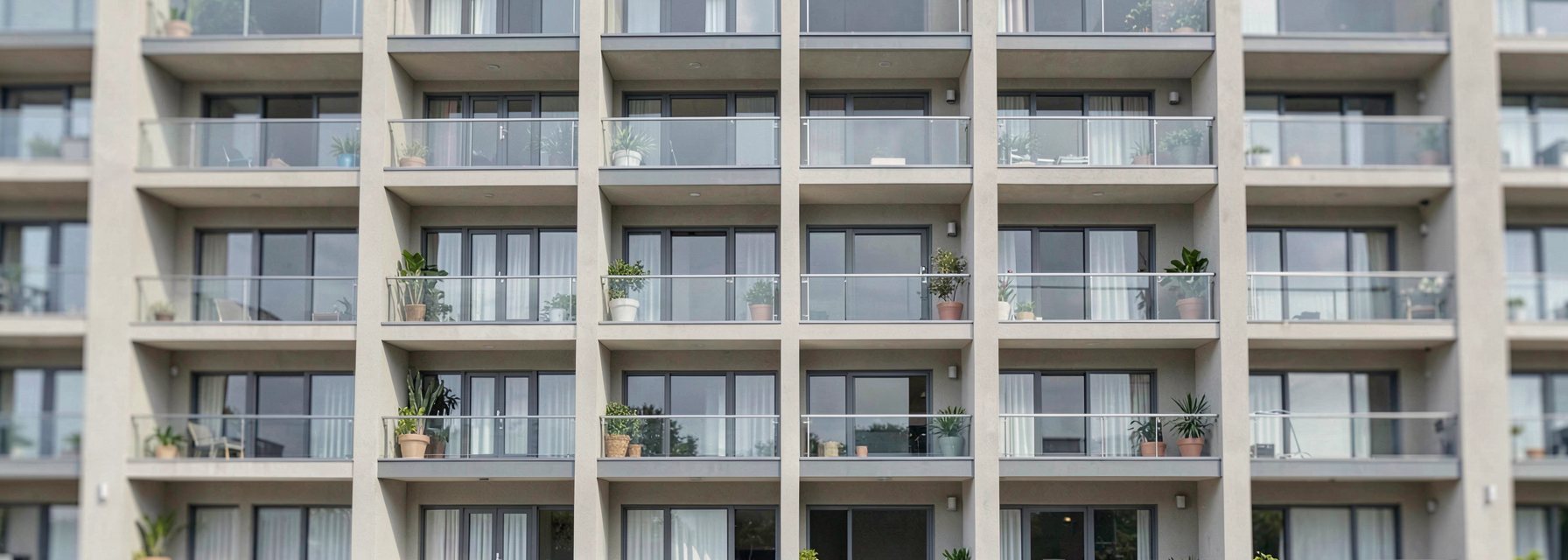
Can you glaze a balcony in a Turkish apartment without asking the neighbours? The Condominium Law No. 634 (Kat Mülkiyeti Kanunu, KMK) does not mention balcony glazing by name. It requires the owners to preserve the building's architectural state and appearance (Art. 19(1)) and bars construction, repairs or installations in the common parts, or a different exterior colour, without the written consent of four-fifths of all owners (Art. 19(2)). In areas with an implementation zoning plan, folding glass panels on balconies need no building permit under the zoning rules (Planned Areas Zoning Regulation, Arts. 2(1), 59(1)), but that text deals with the permit, not the neighbours' consent. If a neighbour alters the building without consent, an owner harmed by it may ask the civil court of peace for the judge's intervention (KMK Art. 33).
This guide follows the text of the legislation. It does not describe how courts or municipalities decide cases, how long proceedings take or what they cost.
1. What Counts as a Common Part of a Turkish Apartment Building?
The Condominium Law No. 634 (Kat Mülkiyeti Kanunu, KMK) separates three things: the independent section (bağımsız bölüm) you own, the annexes (eklenti) attached to it, and the common parts (ortak yerler). Article 2(b) defines common parts as the parts of the main property outside the independent sections that serve its protection and its joint use or benefit.
- Listed by law. Article 4 states that the places and things it lists are in every case common parts. They include the foundations and main walls (ana duvarlar), the elements of the load-bearing system, the walls separating the sections, ceilings and floors, entrances, staircases and lifts (Art. 4(a)); shared installations outside each section (Art. 4(b)); and roofs, chimneys, common roof terraces and gutters (Art. 4(c)).
- The contract and the catch-all. The contract may specify the common parts (Art. 4, first sentence); other places and things necessary for joint use, protection or benefit also count as common parts (Art. 4, last paragraph).
- Annexes. Places outside a section but allotted directly to it are an integral part of that section (Art. 6(1)).
- Who owns the common parts. All owners own the common parts in co-ownership, in proportion to their land shares (arsa payı) (Art. 16(1)).
Article 4 does not name the balcony or the facade; it names the main walls and the load-bearing system. Article 4 does not say whether a particular balcony, its railing or the surrounding wall belongs to the section or the common parts; read the contract, the project and the management plan. Within the section, each owner has an owner's rights under the Civil Code, subject to the KMK (Art. 15).
2. What Does Article 19 Say About the Facade and the Architecture?
- A duty of care. The owners must look after the main property and carefully preserve its architectural state (mimari durumu), its appearance (güzelliği) and its soundness (Art. 19(1)).
- Four-fifths written consent. No owner may have construction, repairs or installations carried out in the common parts, or have the exterior whitewashed or painted in a different colour, without the written consent (yazılı rıza) of four-fifths of all owners (Art. 19(2), first sentence).
- Court-established urgent repair. No consent is needed for repair or strengthening done to its project and technique, where a court has established that a defect in the common parts and installations damages the main building or one or more independent sections and must be repaired urgently, or that strengthening the main building is compulsory (Art. 19(2), second sentence).
- Work inside your own flat. An owner may not carry out, in his or her own section, repairs, installations or changes of a kind that would damage the main building (anayapı) (Art. 19(2), third sentence).
- Connected flats. In the connected parts of sections joined by a ceiling, floor or wall, the owners of those sections may, by their joint consent, carry out repairs, installations or changes that do not damage the main building (Art. 19(2), fourth sentence).
Article 19(3) adds liability: each owner is liable to the other owners for damage he or she causes by fault to the main property and to the other sections.
The threshold in Article 19(2) is counted against all owners (bütün kat maliklerinin), not against those present at a meeting, and the consent must be in writing. Law No. 7579 of 7 May 2026 replaced four-fifths with two-thirds in Article 70, on the management plan of multi-building estates (toplu yapı); it did not change Article 19.
3. Does Glazing My Balcony Need the Other Owners' Consent?
The KMK does not name balcony glazing, but it gives the questions to ask before the installer arrives.
- Does the work touch a common part? Fixing frames into the main walls, the slab edge or other load-bearing elements is work on parts Article 4 lists, and construction or installations in common parts fall under the four-fifths rule of Article 19(2).
- Does it change the architectural state or appearance? A change visible on the facade is measured against the duty in Article 19(1).
- Could it harm the main building? Inside your own section, Article 19(2) bars work that would damage the main building.
- What does the management plan say? The management plan regulates the manner of use and binds all owners like a contract (Art. 28(1)); it may contain rules on balconies and the exterior.
This guide does not say how a court would classify a particular glazing system. The course that follows the text is to obtain the written consent of four-fifths of all owners before installation and keep it with the flat's documents. For the wider range of building disputes, see our guide to condominium disputes under Law No. 634.
4. Who Decides What? Majorities Under the Condominium Law
The building is managed by the owners' assembly (kat malikleri kurulu), which decides the manner of management, subject to the mandatory provisions of the law (Art. 27). Different changes need different majorities.
- Ordinary decisions. The assembly meets with more than half of the owners by number and land share and decides by majority; a second meeting after a failed first one decides by absolute majority of those attending; special quorum rules in the Law are reserved (Art. 30).
- Useful improvements. Owners may not change the common parts on their own; innovations that make them better or easier to use are made on a decision by majority in number and in land share (Art. 42(1)).
- Additional floors. Adding a floor needs, among other conditions, a unanimous decision (Art. 44).
- Outer walls for advertising. Renting the outer walls or roof for advertising needs a unanimous decision of all owners (Art. 45).
- The management plan. Changing it needs the vote of four-fifths of all owners (Art. 28(3)).
Article 19(2) stands beside these rules. For construction, repairs or installations in the common parts and for a different exterior colour, the text asks for the written consent of four-fifths of all owners, and Article 30(3) reserves the separate thresholds that the Law sets elsewhere.
5. Does the Zoning Law Also Require a Permit for Balcony Glazing?
Zoning is a separate layer. Article 21(1) of the Zoning Law No. 3194 (İmar Kanunu) requires a building permit (yapı ruhsatiyesi) from the municipality or governorship, apart from the exception in Article 26, and under Article 21(2) any change to a permitted building needs a new permit.
- Works the Law exempts. Under Article 21(3), works such as plaster, paint, whitewash, joinery (doğrama), floor and ceiling coverings, electrical and plumbing repairs and roof repairs, and other alterations not affecting the load-bearing element that municipal zoning regulations specify, do not need a permit.
- Facade colour and cladding. Municipalities or governorships may determine exterior paint and cladding and roof material and colour, for harmony between buildings and a good appearance (Art. 21(4)).
- Glass panels in the regulation. The Planned Areas Zoning Regulation (Planlı Alanlar İmar Yönetmeliği) covers areas that have an implementation zoning plan (Art. 2(1)). Its Article 59(1) lists openable, closable, folding glass panel applications on balconies (balkonlarda yapılan açılır kapanır katlanır cam panel uygulamaları) among the works that do not need a building permit.
- Where a permit is needed. A major alteration (esaslı tadilat), work that affects the load-bearing element or changes, among other things, the area of common parts or sections or the permit projects, is subject to a permit (Art. 4(1)(y)); a simple repair does not change the load-bearing system or the section's exterior facade (Art. 4(1)(i)).
Article 59(1) speaks to the permit. It does not state that the consent rules of Law No. 634 fall away, and Article 59(2) expressly requires consent under Law No. 634 for heat insulation and the works it lists. Where the municipality has its own zoning regulation, read it too.
For works without a permit or contrary to it, Article 32 of the Zoning Law provides for sealing, a note to the land registry and a period not exceeding one month to put things right, failing which the permit is cancelled and the building is demolished at the owner's expense after a decision of the municipal council or provincial administrative board. Article 42(2)(b) imposes administrative fines for unlawful applications that change the facades and other building elements, where the breach cannot be measured by construction area. This guide does not describe how administrations apply these rules to a balcony enclosure; for structural defects, see our guide to defective construction and contractor liability.
6. Living Together: Good Neighbourliness and Building Use
- The general duty. In using sections, annexes and common parts, owners must follow the rules of good faith (doğruluk kaideleri), in particular not disturb one another, not violate one another's rights and comply with the management plan (Art. 18(1)).
- Tenants and other occupiers. The provisions on owners' obligations also apply to tenants, holders of a right of residence (sükna) and anyone who uses a section permanently on any ground; those who do not perform these obligations are jointly and severally liable with the owners (Art. 18(2)).
- Decisions bind everyone. All owners, their successors and the manager must comply with assembly decisions (Art. 32(2)).
Noise, smoke and other day-to-day nuisance follow the same Article; see our guide to noisy neighbours and Article 18.
7. What Can I Do If a Neighbour Glazed or Altered the Facade Without Consent?
The KMK sets out the steps.
- Raise it within the building. Disputes over use and management are resolved by the assembly (Art. 32(3)), which may meet at any time for an important reason on the request of the manager, the auditor or one third of the owners (Art. 29(2)).
- Ask for the judge's intervention. An owner harmed because another owner, or a person who permanently uses that owner's section under a lease, a right of residence or another ground, fails to perform obligations under the KMK may apply to the civil court of peace (sulh mahkemesi) where the building is located and ask for the judge's intervention (hâkimin müdahalesi) (Art. 33(1)). The judge hears those concerned, decides at once under the KMK and the management plan or, failing these, the general provisions and equity, and sets a short period for compliance (Art. 33(2)).
- Non-compliance. A person who does not carry out the judge's decision within that period is given an administrative fine by the same court, and Article 25 is reserved (Art. 33(3)).
- Persistent breach. If an owner persists for one year in violating the others' rights despite the judge's order under Article 33, the unbearable situation in Article 25 is presumed, and the other owners may ask the judge to transfer that owner's section to them in proportion to their land shares, against its value at the date nearest to the judgment; unless otherwise agreed, suing needs a majority decision of the other owners in number and land share, and the right lapses (düşer) if not used within the periods in Article 25(4) or if the ground for the action ceases (Art. 25).
- Damages. Each owner is liable to the other owners for damage caused by fault to the main property and to the other sections (Art. 19(3)).
The Civil Code No. 4721 adds that an owner may sue to stop any unjustified interference (haksız elatma) with his or her property (TMK Art. 683(2)), and under Article 16(1) KMK the owners hold the common parts in co-ownership. Whether the original state is to be restored, and in which proceedings, is for the court on the facts.
8. If the Assembly Voted on the Alteration: Challenging the Decision
Under Article 33(1), an owner who attended and voted against may bring an annulment action in the civil court of peace within one month from the date of the decision, and an owner who did not attend within one month from learning of it, in any case within six months from the date of the decision. No time limit applies where the decision is non-existent or absolutely void (yok veya mutlak butlanla hükümsüz).
- The decision book. Decisions are written in a notarised book and signed by all owners present; those voting against state their reason (Art. 32(4)).
- Check the threshold. Where the decision concerns works that Article 19(2) subjects to the written consent of four-fifths of all owners, compare the signatures and the list of owners with that threshold.
For the time limits and the parties in detail, see our guide to challenging an owners' meeting resolution under Article 33.
9. Side by Side: Which Change Needs What
| Change or problem | What the text requires | Who decides or where | Provision |
|---|---|---|---|
| Construction, repairs or installations in common parts | Written consent of four-fifths of all owners | The owners, in writing | KMK Art. 19(2) |
| Exterior whitewash or paint in a different colour | Same four-fifths written consent; the administration may set exterior paint and cladding | The owners; the municipality or governorship | KMK Art. 19(2); Zoning Law Art. 21(4) |
| Work inside your own flat | No work that would damage the main building | The owner, within that limit | KMK Art. 19(2) |
| Useful improvement to common parts | Majority of owners in number and in land share | Owners' assembly | KMK Art. 42(1) |
| Folding glass panels on a balcony (zoning side) | No building permit needed, in areas with an implementation zoning plan | Zoning administration | Planned Areas Zoning Regulation Arts. 2(1), 59(1) |
| A neighbour's breach of the Law | Judge's intervention | Civil court of peace | KMK Art. 33(1), (2) |
10. Before You Glaze: A Checklist for Owners
- Read the management plan for any rule on balconies, windows and the exterior of the building (KMK Art. 28(1)).
- Check the approved project to see whether the balcony and the wall you would fix to belong to your section or to the common parts (KMK Arts. 2, 4, 6).
- Ask the installer in writing whether any fixing goes into the main walls or load-bearing elements (KMK Arts. 4(a), 19(2)).
- Collect the written consent of four-fifths of all owners, counted against the full list of owners, before installation (KMK Art. 19(2)).
- Ask the municipality whether the system falls under the permit exemption for folding glass panels and whether it has set rules on exterior colour or materials (Zoning Law Art. 21; Planned Areas Zoning Regulation Art. 59(1)).
- If the flat is let, tell the tenant that the same duties bind him or her (KMK Art. 18(2)).
- If a neighbour has altered the building without consent, keep dated photographs, raise it with the assembly and consider the judge's intervention (KMK Arts. 32(3), 33).
Buying first? The same documents show what the building allows; see our guide to real estate due diligence.
Our real estate and litigation practices advise foreign owners in English; reach us through the contact page.
Frequently Asked Questions
Can I glaze my balcony in Türkiye without asking my neighbours?
The Condominium Law does not name balcony glazing. Where the work involves construction or installations in common parts such as the main walls, or a different exterior colour, Article 19(2) KMK requires the written consent of four-fifths of all owners.
Do I need a building permit for folding glass panels on my balcony?
In areas with an implementation zoning plan, Article 59(1) of the Planned Areas Zoning Regulation exempts folding glass panel applications on balconies from the building permit. The consent rules of Law No. 634 are a separate question.
Is the four-fifths counted among the owners at the meeting or among all owners?
Article 19(2) KMK refers to the written consent of four-fifths of all owners (bütün kat maliklerinin), not of those attending a meeting.
My neighbour enclosed a balcony and changed the facade without consent. What can I do?
Under Article 33 KMK, an owner harmed by another owner's failure to perform obligations under the Law may ask the civil court of peace for the judge's intervention. The judge sets a short period for compliance, and non-compliance leads to an administrative fine.
Can the owners' assembly approve a balcony enclosure by a simple majority?
Article 30(3) KMK reserves the Law's special thresholds, and Article 19(2) asks for the written consent of four-fifths of all owners for construction or installations in common parts.
Do these rules bind my tenant?
The provisions on owners' obligations do. Under Article 18(2) KMK, they also apply to tenants, and a tenant who does not perform them is jointly and severally liable with the owners.