
Neighbour Law & Property Access
Landlocked Plot or Villa in Türkiye With No Road Access: Claiming a Right of Way (Geçit Hakkı) Under TMK Article 747
A hillside villa or a plot among olive groves can be registered in its owner's name and still have no sufficient way to the road. The Turkish Civil Code answers this in Article 747: an owner who has no sufficient passage to a public road may ask the neighbours for a right of way (geçit hakkı), in return for full payment. This guide sets out what Article 747 says, the order in which neighbours are approached, the separate rule for pipes and cables, how an easement is registered in the land register, how it can end, and how mediation and the courts come in.
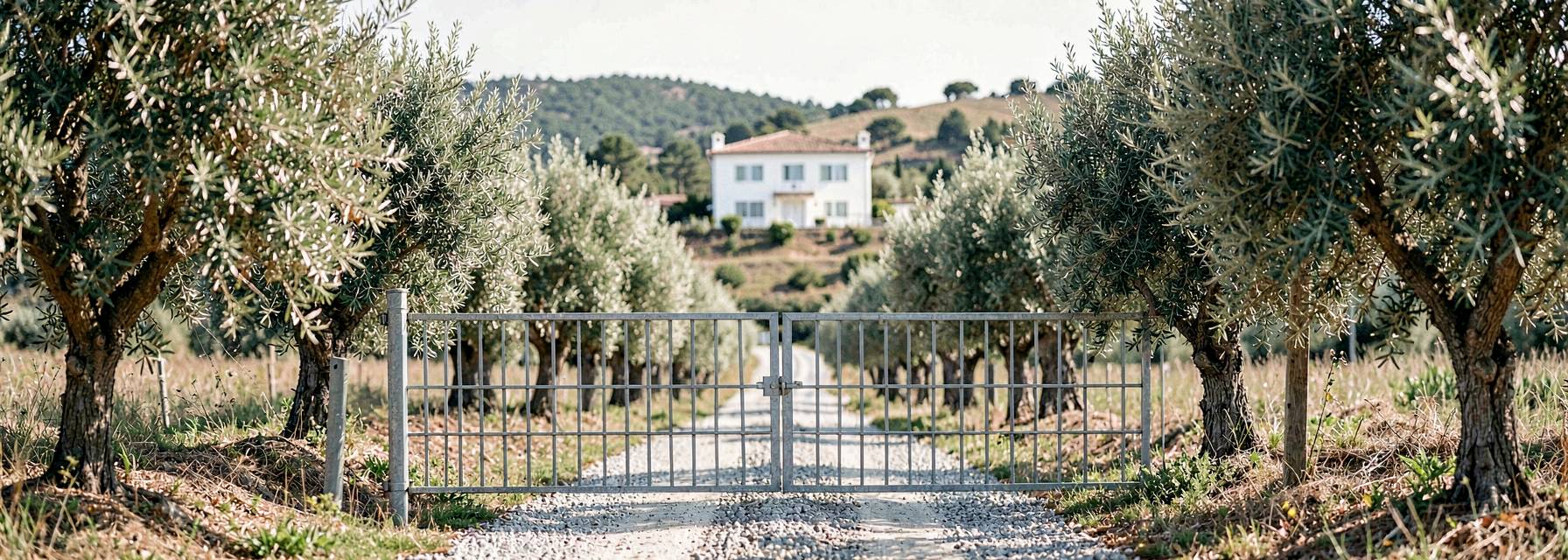
This guide is written for foreign nationals who have bought, or are thinking of buying, a plot, a field or a villa in Türkiye and who find that the way to it crosses somebody else's land. It covers the Civil Code rules on a compulsory right of way, the separate rule for pipes and cables, the registration of the right, how it ends, and the mediation and court steps. It describes what the statutes say. It does not cover zoning, cadastral roads, the restrictions on which plots a foreign national may own, or the cost of registration, and it does not describe how a particular court has decided a case.
1. What Article 747 Says: Who May Ask, Whom, and for What
Article 747 of the Turkish Civil Code No. 4721 (Türk Medeni Kanunu, TMK) carries the Code's own caption “compulsory passage” (zorunlu geçit). Its first paragraph provides that an owner who has no sufficient passage to get out from his or her immovable to a public road (genel yol) may ask the neighbours to grant a right of way (geçit hakkı), in return for full payment (tam bir bedel). Four elements can be read out of that sentence:
- The person asking is the owner. The article speaks of the owner (malik) of the immovable. Its text does not mention nationality. Whether a particular foreign national may own a particular plot is a separate question that this guide does not cover.
- There must be no sufficient passage. The words are yeterli geçidi bulunmayan, an owner without a sufficient passage. The article does not define what is sufficient. An owner with no passage at all and an owner whose passage is not sufficient are both within the words; whether a given track is sufficient is for the court to assess on the facts.
- The passage is to a public road. The article names a public road as the destination and does not define the term.
- It is a right to ask, against payment. The owner “may ask” (isteyebilir) that the neighbours grant the right, and the payment is full payment.
The article therefore starts from a request. It does not name a form for the request or a deadline for making it, and it says nothing about how the right is entered in the land register; Section 6 returns to registration. For a foreign buyer, the practical consequence is that the road question belongs in the checks made before the money moves. Our guides on buying property in Turkey as a foreigner and on real estate due diligence cover the wider purchase process.
2. Which Neighbour Is Asked First: Article 747(2) and (3)
The second paragraph sets an order among the neighbours. It provides that this right is exercised first against the neighbour from whom it is most suitable (en uygun düşen), according to the earlier ownership and road situation (önceki mülkiyet ve yol durumu), to request the passage, and after that against the neighbour who will suffer the least harm from it.
The Code does not list what counts as the earlier ownership and road situation, and it does not say how harm is measured. Both are for the court on the facts of the case. A plan of the plots along the possible routes, the land registry record of each plot and any older track or road visible on the ground are the kind of material that shows that situation to a court or to a neighbour.
The third paragraph adds the standard for the route itself: the compulsory passage is determined having regard to the interests of both sides (iki tarafın menfaati gözetilerek). The article gives no width, surface or length for a passage. In a negotiation, that means the route, its width and the kind of use (on foot, with vehicles) are points the parties describe in their own agreement; in a lawsuit, they are points the claim describes and the court assesses.
3. Payment: What “Full Payment” Does and Does Not Tell You
Article 747(1) makes the grant of the right of way a matter of tam bir bedel, which this guide renders as full payment. The article does not state an amount, a formula or a valuation method, and it does not say in what form the payment is made or at what moment. If the neighbours agree to the passage, the payment is part of that agreement. If they do not agree, the payment is a point the court assesses on the facts of the case.
Two other articles speak of payment in a different setting, and their words should not be read into Article 747: Article 744 on pipes and cables, where the burdened owner's damage must be paid in advance, and Article 745, where the owner may in extraordinary cases ask for part of the parcel to be bought (Section 4). Article 747 speaks of full payment and does not state when it is to be made.
A buyer negotiating the purchase of a plot that has no sufficient way to the road can ask the seller and the neighbours, before signing, what has been agreed about the passage and in which document. A figure mentioned in conversation about payment for the passage does not come from the Code.
4. Pipes, Cables and Channels Are a Separate Right: Articles 744 and 745
A road is one need; water, drainage, gas and electricity are another. The Code deals with them separately, in Articles 744 and 745 under the heading on the passage of lines (mecra geçirilmesi). Article 744(1) provides that every immovable owner, on condition that the whole of the damage he or she will suffer is paid in advance, is obliged to tolerate water channels, drainage canals, pipes for gas and the like, and electric lines and cables being run under or over his or her land, where running them from another place is impossible or excessively costly.
- Expropriation rules: where the passage of lines is subject to the rules on expropriation, the Code's neighbourhood provisions on lines do not apply (Art. 744(2)).
- Registration: the right to run lines is entered in the land register at the request of the right holder, on condition that the holder pays the expenses (Art. 744(3)).
- The burdened owner's interest: the owner of the burdened immovable may ask for his or her interest to be taken into account in a manner consistent with equity (hakkaniyet) (Art. 745(1)).
- Extraordinary cases: where there are extraordinary circumstances in the lines that will pass over the land, the owner may ask that an appropriate part of the parcel the lines pass over be bought at a price that fully covers the damage (Art. 745(2)).
Article 747 speaks of a passage (geçit); Article 744 speaks of lines (mecra). A lane and a pipe or cable laid along it are dealt with in separate articles, each with its own wording on payment (and Article 744 also on registration). A villa owner whose plan includes both a way in and a water or electricity connection across a neighbour's land should therefore read the two articles side by side and describe each need separately to the neighbour or in the claim.
5. Field Tracks and Other Passages: Articles 748 and 789
Article 748, headed diğer geçit hakları (other rights of passage), deals with a different group. Its first paragraph provides that the owner's right to enter a neighbouring immovable temporarily to operate or improve his or her immovable or to build on it, and field tracks (tarla yolu), animal-watering tracks, winter passages, log-slide tracks and chutes, and other similar passages, are subject to special law provisions. The second paragraph adds that if there is no special law provision, local custom (yerel âdet) applies.
Article 789 turns to the same fallback for the scope of such rights: in determining the scope of rights of passage such as a field track, a footpath or a carriage passage, of the rights of animal grazing, animal watering and taking water to fields or channels, and of similar rights, the agreement between the parties or the special law provisions apply, and if there are none, local custom.
Article 748 does not say that the compulsory passage of Article 747 is one of these passages. Which provisions govern a particular strip of land, for example a track that the neighbours have used for a long time, depends on the legal character of that strip, which is assessed from the land registry records and the facts. The Code does not answer it in general terms, and neither does this guide.
6. Making the Right Permanent: Registration, Official Form and Scope (Articles 779-781, 787 and 748(3))
The Code regulates the easement (irtifak hakkı) among the limited real rights. Under Article 779(1), an easement in favour of an immovable is a burden placed on one immovable in favour of another, which obliges the owner of the burdened immovable to refrain from exercising some of the powers that ownership gives, or to tolerate the owner of the benefited immovable using the burdened immovable in a certain way. A right of way across a neighbour's land is the kind of right this definition describes. Two further articles set the formalities:
- Registration: Article 780(1) provides that registration in the land register is required for the creation of an easement.
- Official form: Article 781 provides that the validity of a contract for the creation of an easement depends on its being drawn up in official form (resmî şekil).
A right of way can be sought in three ways, and the texts speak to each of them differently.
- By agreement with the neighbour. The contract must be in official form (Art. 781) and the easement must be registered (Art. 780(1)).
- By agreement reached at mediation, where the dispute is one covered by Article 18/B. Under Article 18/B(3) of the Mediation Law No. 6325, obtaining an enforceability annotation (icra edilebilirlik şerhi) is compulsory, and for agreements concerning an immovable it is obtained from the civil court of peace of the place where the immovable is located. Under Article 18/B(5), a party to an agreement on the transfer of an immovable or the creation of a limited real right on an immovable may, after the annotation, apply to the land registry office, which carries out the review required by the land legislation and then registers the request without drawing up an official deed.
- By a claim to the court under Article 747. Article 747 itself says nothing about registration. Article 748(3) provides that rights of passage arising directly from the law arise without registration in the land register, but those of a continuing nature are shown in the annotations column (beyanlar sütunu), while Article 780(1) requires registration for the creation of an easement. Which of the two governs a right of way claimed under Article 747, and how a court decision is carried to the land register, are points to settle in the claim and with the land registry office. This guide does not decide them.
Once an easement is registered, the registration matters for its scope. Article 787 provides that to the extent the registration expressly states the powers and duties arising from the easement, it is the basis for determining its scope, and that where the registration does not make it clear, the scope is determined, within the limits of the registration, according to the ground on which the right was acquired or the manner in which it has been used for a long time without dispute and in good faith. Stating the route and the kind of use precisely in the agreement or the claim is therefore worth the effort, because the registration is the basis for the scope to the extent that it states the powers and duties expressly.
7. Living With the Right: Use, Obstruction and Ending (Articles 786, 785 and 783)
Article 786 sets duties on both sides once an easement exists. Under the first paragraph, the holder of the easement may take the measures necessary to protect and use the right, but must use it in the way that causes the least harm to the owner of the burdened immovable. Under the second paragraph, the owner of the burdened immovable cannot act in ways that prevent or make more difficult the use of the easement.
The Code does not list examples of such acts. Whether a particular gate, lock, fence, planting or parked vehicle prevents or makes more difficult the use of a registered right of way is assessed on the facts, with the registration and the scope rules of Article 787 in hand.
The Code also says how an easement ends. Article 783 provides that an easement ends with the deletion of the registration, or with the disappearance (yok olması) of the burdened or the benefited immovable. Article 785(1) adds that if the benefited immovable has no benefit left from the right, the owner of the burdened immovable may ask for the right to be deleted. Whether a particular right of way has reached that point is a question of fact for the court. The Code deals with further cases of ending and of deletion in neighbouring articles, which this guide does not cover.
8. Mediation and the Court: Mediation Law Article 18/B and Civil Procedure Articles 2, 4 and 12
Article 18/B(1) of the Mediation Law No. 6325 (Hukuk Uyuşmazlıklarında Arabuluculuk Kanunu, HUAK) makes applying to a mediator before a lawsuit a condition of the action (dava şartı) in several listed disputes. The list includes, in paragraph (1)(ç), disputes arising from neighbour right (komşu hakkından kaynaklanan uyuşmazlıklar). The provision does not name the right of way of Article 747. Article 747 speaks of what the owner may ask of the neighbours (komşularından), and whether a particular dispute is one arising from neighbour right is a point the mediation office and the court assess on the facts. A claimant who is unsure has reason to deal with that question at the start, because the consequence of getting it wrong is set out in Article 18/A(2):
- Where to apply: the application is made to the mediation office in the place of the court having jurisdiction over the dispute (Art. 18/A(4)).
- Final report: the claimant must attach to the statement of claim the original, or a mediator-approved copy, of the final report stating that no agreement was reached; where it is found that a claim was filed without applying to a mediator, the action is dismissed on procedural grounds for lack of a condition of the action, without any other step being taken (Art. 18/A(2)).
On the court, the Code of Civil Procedure No. 6100 (Hukuk Muhakemeleri Kanunu, HMK) gives three texts to read together. Article 2(1) provides that regardless of the value or amount of the subject matter, in actions concerning property rights and actions concerning personal status, the competent court is the court of first instance for civil matters (asliye hukuk mahkemesi), unless a provision provides otherwise. Article 4(1) lists the matters the civil courts of peace (sulh hukuk mahkemeleri) hear regardless of value: disputes over leased immovables (a), the partition of property and the ending of co-ownership (b), actions solely for the protection of possession (c), and actions that the Code or other laws assign to the civil court of peace (ç). The right of way of Article 747 is not named in that list.
On territorial jurisdiction, Article 12 has three paragraphs. Paragraph 1 provides that in actions concerning a real right on an immovable, or capable of causing a change in the holding of a real right, and in actions concerning possession of an immovable or the right of retention, the court of the place where the immovable is located has exclusive jurisdiction. Paragraph 2 provides that actions concerning easements are brought in the court of the place where the immovable on which the easement is created is located. Paragraph 3 provides that if these actions concern more than one immovable, they may be brought in the place of one of the immovables for the others as well.
Which of these texts applies to a particular Article 747 claim, and which court is competent, is decided by the court on the claim as filed. Under Article 114(1) of the same Code, the court's competence (görev) is a condition of the action, and so, in cases where jurisdiction is exclusive, is the court's having jurisdiction (yetki). In a claim, the plot-by-plot description (the claimant's plot, the plots on the proposed route and their land registry details) is what lets the court place the case.
9. The Three Passage Rules Side by Side
The table compares the three sets of rules that a landlocked owner may meet. Each entry follows the text of the article cited.
| Point | Compulsory passage (TMK 747) | Pipes, cables and channels (TMK 744-745) | Field tracks and similar passages (TMK 748, 789) |
|---|---|---|---|
| Who the rule helps | The owner of an immovable that has no sufficient passage to get out to a public road (747(1)) | The person who needs to run lines across land where running them from another place is impossible or excessively costly (744(1)) | Not stated in Article 748; the passages are subject to special laws and, if there are none, to local custom (748(1)-(2)) |
| What it covers | A right of way (geçit hakkı) | Water channels, drainage canals, gas and similar pipes, electric lines and cables, under or over land (744(1)) | Temporary entry onto a neighbouring immovable to operate, improve or build; field tracks, animal-watering tracks, winter passages, log-slide tracks and chutes, and similar passages (748(1)) |
| Payment | In return for full payment (747(1)) | The whole of the damage is paid in advance (744(1)); in extraordinary cases the owner may ask that part of the parcel be bought at a price fully covering the damage (745(2)) | Not stated in Articles 748 or 789 |
| Order of approach | First the neighbour for whom the request is en uygun düşen according to the earlier ownership and road situation, then the neighbour who will suffer the least harm (747(2)) | Not stated in the same terms; the condition is that running the lines from another place is impossible or excessively costly (744(1)) | Not stated |
| Land register | Not addressed in Article 747; see Articles 748(3) and 780(1) | Entered at the request of the right holder who pays the expenses (744(3)) | Article 748(3), whose words are not limited to the passages in 748(1): rights of passage arising directly from the law arise without registration; continuing ones are shown in the annotations column |
10. The Owner Without Access and the Owner of the Land the Passage Crosses
The second table sets the two owners side by side. It follows the text of the articles cited and does not describe court practice.
| Point | Owner of the plot without sufficient access | Owner of the land the passage crosses |
|---|---|---|
| Basis | May ask the neighbours to grant a right of way in return for full payment (TMK 747(1)) | May be asked in the order set out in Article 747(2); the passage is determined having regard to the interests of both sides (747(3)) |
| Agreed right | Contract in official form (781); registration required for creation (780(1)) | Same provisions apply (781; 780(1)) |
| Use of the right | May take the measures needed to protect and use the right; must use it in the way that causes the least harm to the burdened owner (786(1)) | Cannot act in ways that prevent or make more difficult the use of the easement (786(2)) |
| Ending | The easement ends with deletion of the registration or the disappearance of either immovable (783) | May ask for deletion if the benefited immovable has no benefit left from the right (785(1)) |
| Before filing a claim | Application to a mediator is a condition of the action in disputes arising from neighbour right (HUAK 18/B(1)(ç)); whether the claim falls there is assessed by the office and the court | Same, if the neighbour is the claimant |
| Court | Court determined by HMK Articles 2, 4 and 12 on the claim as filed | Same |
11. Step by Step: From a Closed Gate to a Registered Right of Way
The steps below follow the order in which the provisions come into play. They concern documents and decisions an owner can prepare; they are not a description of court practice.
- Get the land registry record of your plot and of each neighbouring plot along the possible routes, and note every existing track or road that leads to the public road.
- Describe what you need: a way in on foot or with vehicles, and separately any water, drainage, gas or electricity line (TMK Arts. 747 and 744).
- Approach the neighbours in the order of Article 747(2): first the one for whom the request is en uygun düşen on the earlier ownership and road situation, then the one who will suffer the least harm.
- If you agree, put the route, the width, the kind of use and the payment into a contract in official form, and have the easement registered (TMK Arts. 781, 780(1) and 787).
- If you do not agree, apply to the mediation office where the competent court is located (HUAK Arts. 18/B(1)(ç) and 18/A(4)); whether the dispute is one arising from neighbour right is assessed on the facts, so check that point at the start.
- If you agree at mediation, obtain the compulsory enforceability annotation from the civil court of peace of the place of the immovable, then apply to the land registry office (HUAK Arts. 18/B(3) and 18/B(5)).
- If you do not agree, file the claim with the final mediation report attached (HUAK Art. 18/A(2)), describing the plots and the route and stating the payment you offer, before the court determined under HMK Articles 2, 4 and 12.
- After the right exists, keep the registration, the plan and the agreement together: they set the scope (TMK Art. 787) and they are what you rely on if the use of the passage is obstructed (TMK Art. 786(2)).
Each of these points is easier to handle with the documents in front of you: the land registry records, a plan showing the plots and the route, photographs of the existing track, and any message exchanged with the neighbours about the passage. Where the problem with a neighbour is noise or smoke rather than access, our guide to noisy neighbours in Turkey covers a different neighbour-law rule.
Frequently Asked Questions
Can I force a neighbour to give me a road to my plot or villa in Türkiye?
Article 747(1) of the Civil Code provides that an owner who has no sufficient passage to get out from his or her immovable to a public road may ask the neighbours to grant a right of way, in return for full payment. The article starts from a request, and the court assesses on the facts whether the passage is sufficient.
Which neighbour has to give the passage?
Under Article 747(2), the right is exercised first against the neighbour from whom it is most suitable (en uygun düşen), according to the earlier ownership and road situation, to request the passage, and after that against the neighbour who will suffer the least harm from it. Under Article 747(3), the compulsory passage is determined having regard to the interests of both sides.
Do I have to pay for a right of way?
Article 747(1) speaks of full payment (tam bir bedel). The article does not state an amount, a formula or the moment of payment. If the neighbours agree, the payment is part of the agreement; if not, it is assessed by the court on the facts.
Does the right of way have to be registered at the land registry?
Article 747 says nothing about registration. Article 780(1) provides that registration in the land register is required for the creation of an easement, and Article 781 provides that a contract creating an easement must be in official form. Article 748(3) provides that rights of passage arising directly from the law arise without registration, and that those of a continuing nature are shown in the annotations column. Which provision governs a right claimed under Article 747 is a point to settle in the claim and with the land registry office.
Does the right of way also cover water, gas or electricity lines?
Lines are dealt with in Article 744. Every immovable owner, on condition that the whole of the damage he or she will suffer is paid in advance, is obliged to tolerate water channels, drainage canals, pipes for gas and the like, and electric lines and cables being run under or over his or her land, where running them from another place is impossible or excessively costly. Article 747 speaks of a passage, not of lines.
Do we have to go to mediation before a lawsuit about a right of way?
Article 18/B(1)(ç) of the Mediation Law No. 6325 makes applying to a mediator before a lawsuit a condition of the action in disputes arising from neighbour right. The provision does not name the right of way of Article 747, and whether a given dispute falls within it is assessed on the facts. Under Article 18/A(2), a claim filed without applying to a mediator, where one was required, is dismissed on procedural grounds.
Which court hears the claim, and where is it filed?
Article 2(1) of the Code of Civil Procedure gives the court of first instance for civil matters (asliye hukuk mahkemesi) general competence in property-right actions unless a provision provides otherwise, and Article 4(1) lists the matters of the civil courts of peace, which does not name the right of way. Article 12 points to the court of the place where the immovable is located: exclusively for actions concerning a real right on an immovable (paragraph 1), and for actions concerning easements, the place of the immovable on which the easement is created (paragraph 2).
Can a registered right of way end later?
Under Article 783, an easement ends with the deletion of the registration or the disappearance of the burdened or the benefited immovable. Under Article 785(1), if the benefited immovable has no benefit left from the right, the owner of the burdened immovable may ask for its deletion. Under Article 786(2), the burdened owner cannot act in ways that prevent or make more difficult the use of the easement.